The Woman Who Owns Nothing Has 49 Tabs Open About Linen and a Notion Board Called 'Intentional Living'
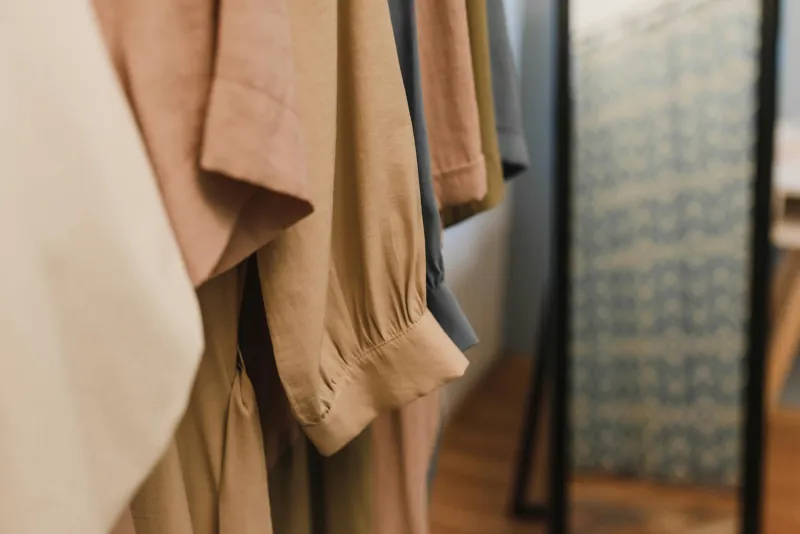
The Woman Who Owns Nothing Has 49 Tabs Open About Linen and a Notion Board Called 'Intentional Living'
Somewhere on Instagram right now, a woman is standing in a white room in a £220 ecru wide-leg trouser, holding a ceramic mug that cost more than your first month's rent, explaining calmly that she owns thirty-seven items of clothing and has never felt more free. The caption will include the phrase 'intentional living.' There will be a link in bio to her 'free capsule wardrobe guide,' which is a PDF that costs £14.99.
Welcome to minimalism in 2024, where owning less has somehow become the most maximalist, exhausting, and financially ruinous aesthetic on the internet.
The capsule wardrobe industrial complex is booming, and it would like you to know that it's not a trend. It's a philosophy. It's a practice. It is, if you look at the Substack posts often enough, practically a religion — one with a very strict dress code that is, paradoxically, all about having no dress code, as long as that non-dress-code is entirely beige and costs upwards of £1,400 to assemble.
A Brief History of Owning Exactly the Right Amount of Things
The capsule wardrobe concept is not new. Susie Faux coined the term in the 1970s; Donna Karan ran with it in the 80s. The idea was sensible enough: a small collection of versatile, quality pieces that work together, reducing decision fatigue and, theoretically, spending.
This was before the internet gave everyone a platform and 'reducing spending' became a content vertical.
Modern capsule wardrobe culture has taken the original concept and done to it what gentrification does to a perfectly functional neighbourhood: kept the aesthetic bones, removed all the affordability, and added a wine bar where the Spar used to be. The capsule wardrobe of 2024 is not about spending less. It is about spending better, which is what people say when they mean 'spending more but feeling righteous about it.'
The influencer who pioneers this space — and there are thousands of them, a minimalist army in matching oatmeal — will typically own between thirty and fifty items of clothing. These items will be documented in a spreadsheet (shared with followers as a 'free resource'), photographed on a white wall in flat lays so serene they look like the inventory of a very tasteful crime scene, and discussed at length in terms of their cost per wear, a metric that allows a £340 cashmere jumper to be reclassified as a bargain if you wear it enough times before it pills.
The Beige Problem
Let us talk about the colour palette, because it is inescapable and it is beige.
Not just beige. Ecru. Oat. Sand. Warm white. Parchment. Greige (grey-beige, which is simply beige that went to university). The capsule wardrobe colour palette operates within a range so narrow that if you printed it on a Dulux chart, it would occupy approximately four centimetres.
This is justified, in the content, by the concept of a 'neutral foundation' — the idea that if everything is the same colour, everything works together, which is technically true in the same way that if you only eat beige food, you never have to think about what to pair with what. Correct. Also: beige.
The irony — and it is a rich, full-bodied irony, which is more than can be said for the colour palette — is that owning forty-seven items in the same colour range is not minimalism. It is hoarding with better photography. It is the same psychological impulse that fills other people's spare rooms with craft supplies or vintage paperbacks, simply redirected toward linen and expressed as self-improvement.
The woman with forty-seven beige items is not a minimalist. She is a collector. She has simply found a collector community that calls itself the opposite.
The Spreadsheet Is the Personality
Perhaps the most revealing artefact of the capsule wardrobe genre is the documentation. The spreadsheets. The Notion boards. The wardrobe tracking apps. The colour-coded seasonal 'edits.' The 'what I wore this week' content, which is technically a fashion diary but presented with the forensic rigour of an accountancy audit.
Your average capsule wardrobe influencer spends, by conservative estimate, approximately four hours a week thinking about the thirty items they own so that they never have to think about what to wear. This is the central paradox of the genre and nobody is allowed to mention it.
The Notion board — always called something like 'Intentional Wardrobe 2024' or 'My Slow Fashion Journey' — will contain a master item list, a cost-per-wear calculator, a 'wishlist' (which rather undermines the 'I need nothing' energy but let's continue), a seasonal capsule breakdown, and a mood board of 'outfit formulas' that are, in practice, just the same wide-leg trouser photographed with slightly different tops.
This is more administrative labour than most people apply to their actual jobs. But it doesn't count as consumption, you see, because it's intentional.
The Brands That Understood the Assignment
The capsule wardrobe content economy has produced, naturally, a thriving ecosystem of brands designed specifically to service it — and they are extraordinary. They have names that sound like yoga studios or Scandi furniture companies. Their Instagram bios contain words like 'considered,' 'slow,' 'craft,' and, inevitably, 'intentional.' Their websites are white. Their models stand in fields looking contemplative. Their linen shirts cost £180 and come in four shades of the same colour.
These brands understand their customer completely. She is not buying a shirt. She is buying an identity. She is buying the right to say 'I only buy quality pieces that will last' while spending the same annual amount on clothing as someone who shops at Zara every week, but feeling considerably better about it.
The genius of the slow fashion brand is that it has successfully reframed the purchase decision as an ethical act. You're not buying another linen shirt. You're investing in your capsule. You're choosing quality over quantity. You're supporting independent makers. The transaction is not consumption — it is virtue, made available for £180 plus £6.99 postage.
The Thirty-Item Wardrobe That Required Buying Forty Things to Achieve
Here is something the capsule wardrobe content does not discuss: the process of building the capsule wardrobe, which inevitably involves buying quite a lot of things in order to arrive at the point where you own a small number of things.
There are the transitional purchases — the 'almost right' pieces acquired while searching for the 'perfect' version. The items that seemed capsule-appropriate but didn't 'earn their place' (a phrase used without irony). The starter-capsule phase, before you understood your 'personal uniform.' The upgrade phase, when you replace the M&S version with the £180 version. The refinement phase. The 'I've finally found my style' phase, which precedes the next refinement phase by approximately one season.
The capsule wardrobe, fully assembled, is the destination. The journey involves an amount of shopping that would make a fast fashion devotee feel judged.
But it's fine, because it's intentional.
It's all intentional.
The Notion board says so.