The Last High Street: A Town Where Every Charity Shop Is Just Laundering the Other's Unsold Stock
The Last High Street: A Town Where Every Charity Shop Is Just Laundering the Other's Unsold Stock
Category: Style & Culture
Mottfield-on-Wane does not exist. But it does, in the way that only fictional places can, exist absolutely everywhere.
You know Mottfield-on-Wane. You grew up in it, or near it, or you drove through it once on the way to somewhere else and thought, briefly, that it looked a bit sad, and then forgot about it entirely until you read a think-piece about the 'death of the high street' and felt a generalised guilt that lasted until your coffee got cold. It has a Greggs. It has a vape shop with a neon sign that says 'CLOUD 9' in purple. It has a betting shop that has been there since 1987 and will outlast everything, including the sun.
And it has, currently, four charity shops. Which is three more than it had in 2010, and which represent, in the local council's most recent regeneration report, a 'vibrant and diverse retail ecosystem.'
The Circle of Life (Retail Edition)
The four charity shops of Mottfield-on-Wane are as follows: Oxfam, at the top end of the high street, near the empty unit that used to be a Thorntons; British Heart Foundation, two doors down from the former New Look (now a trampoline fitness studio that opened in 2021 and closed in 2022, the unit now dark and full of someone's unrealised ambition); Cancer Research UK, opposite the precinct; and a local hospice shop called Second Chances, which is, in the circumstances, doing a lot of heavy lifting as a metaphor.
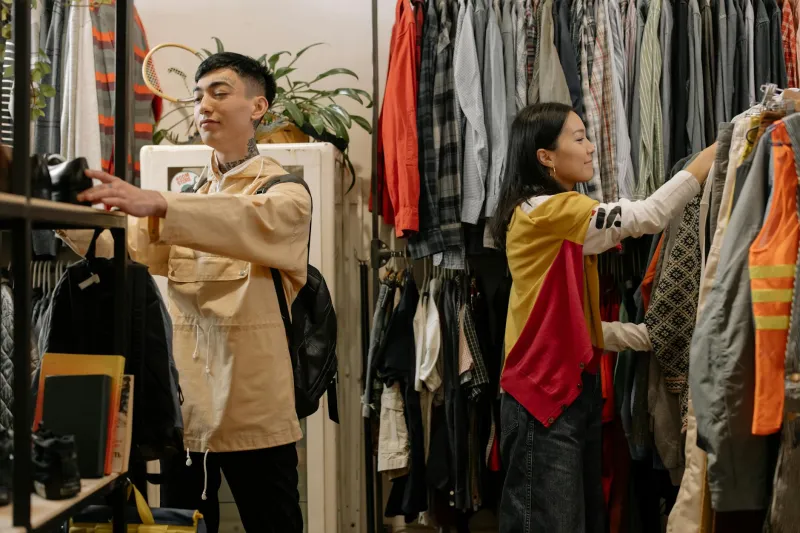
Our fashion correspondent — equipped with a notebook, a willingness to rifle through rails, and a beige Marks & Spencer fleece purchased for £2.50 from the Oxfam on a previous visit — spent one Tuesday conducting what she describes as 'the most existentially destabilising day of my professional career,' which is saying something, given that she once reviewed a collection shown entirely in a disused Wetherspoons.
The fleece — let us call it Gerald — began its journey at Oxfam, where it had been priced at £4.99 and had sat on the rail for, by the volunteer's estimation, 'at least six weeks, maybe longer, we try not to think about the ones that don't move.' When stock fails to sell at Oxfam, the volunteer explained, it is periodically removed and donated — quietly, without ceremony — to another local charity shop, to give it 'a fresh start.'
Gerald was currently on his fourth fresh start.
He had been to British Heart Foundation, where he was priced at £3.50 and also did not sell. He had been to Cancer Research, where someone had put him in the window display briefly before reconsidering. He had been to Second Chances, where a volunteer had briefly considered him for the 'premium vintage' rail before correctly identifying him as a fleece from approximately 2003 and returning him to the general population.
And now he was back at Oxfam. Slightly more travelled. No more desirable.
'This Is Actually Sustainable Fashion Done Right' — An Instagram Caption
While Gerald was completing his fourth circuit of the Mottfield-on-Wane retail economy, a young woman with an excellent camera phone was photographing him. She had come up from London — a two-hour train journey she described as 'such a vibe, honestly, I love a proper Northern town' (Mottfield-on-Wane is in Worcestershire) — specifically to 'go thrifting,' which is what people from London call charity shopping when they want it to sound intentional rather than desperate.
Her name was Cordelia. She had 47,000 Instagram followers. She bought Gerald for £4.99, which she paid with a contactless card, and she photographed him against the Oxfam window display with the caption: 'Slow fashion. Real people. Real places. This is what sustainable style actually looks like 🤍 #ThriftedFashion #SecondHandFirst #QuietLuxury #Worcestershire'
The post received 8,400 likes. Fourteen people commented asking where she'd found it. She replied to none of them.
Gerald, for his part, was last seen in a flat in Peckham, draped over a chair in the background of a mirror selfie. He looked, against all odds, quite content.
The Politicians Who Will Save the High Street (Again)
It is important, at this juncture, to acknowledge the brave men and women who have dedicated significant portions of their careers to promising the revival of the British high street, and who have delivered, in aggregate, a series of consultation documents, a handful of pop-up markets, and at least three 'High Street Tsar' appointments whose powers appear to extend only to giving interviews on Radio 4.
Mottfield-on-Wane's local MP, a man who wears the expression of someone who has just remembered something unpleasant, has promised a 'high street renaissance' at each of the last four general elections. The renaissance has thus far manifested as a repainted litter bin, a brief period during which the council subsidised a farmers' market (cancelled after six weeks due to 'insufficient footfall'), and a press release describing the charity shop density as 'evidence of a thriving community spirit.'
He is not wrong, exactly. The charity shops are full of volunteers who give their time generously, who know their regulars by name, who provide something genuinely warm and human in a space that retail has otherwise abandoned. The problem is not the charity shops. The problem is that the charity shops are the last thing standing, and we have decided to call that a success.
The Aestheticisation of Collapse
There is a particular cruelty to the way that fashion and social media have learned to aestheticise economic decline. The 'poverty chic' visual vocabulary — the peeling shop fronts rendered beautiful by a VSCO filter, the charity shop rail photographed like a couture archive, the 'authentic' high street that is authentic precisely because it has been stripped of any investment — turns the evidence of abandonment into content.
Cordelia's post about Gerald the fleece will have been seen by 47,000 people, most of whom will feel good about sustainable fashion, none of whom will move to Mottfield-on-Wane and open an independent shop. The town will remain as it is. The circle will continue.
Oxfam will donate to British Heart Foundation. British Heart Foundation will donate to Cancer Research. Second Chances will keep the faith. And somewhere in the loop, a beige fleece will keep travelling, carried on the slow current of things that nobody quite wants but nobody can quite bring themselves to throw away.
Which is, now that we think about it, also a reasonable description of British retail policy since 2010.
The Hemline Herald would like to clarify that Mottfield-on-Wane is fictional. Any resemblance to your hometown is entirely your problem.