Cuff and Nonsense: The Elaborate Performance Art of Rolling Your Sleeves Up
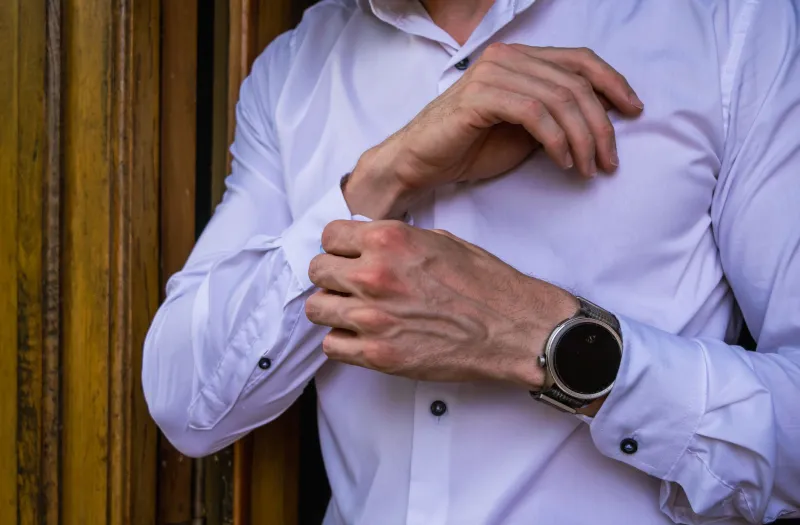
Somewhere in a gastropub in Chiswick, a man is rolling his sleeves up. He is doing this slowly, deliberately, with the focused serenity of a monk arranging prayer beads. He is not hot. There is no manual labour incoming. He simply needs everyone in the room to understand that he is the kind of person who rolls his sleeves up — and that this, in itself, is a statement of profound personal philosophy.
Welcome to the Great British Sleeve Roll: a gesture so loaded with social semaphore that it has spawned YouTube tutorials with hundreds of thousands of views, entire Instagram accounts dedicated to 'effortless' shirting, and a cottage industry of Oxford-cloth button-downs engineered specifically to be folded back, despite the fact that the whole construction will have gone limp and baggy within the time it takes to order a second pint of something murky from Dorset.
A Brief and Entirely Unnecessary History
The sleeve roll, in its original form, was functional. Farmers rolled their sleeves up because they were about to do something with a cow. Factory workers rolled their sleeves up because machinery was involved. Nobody was photographing them for a 'Sunday Dressing' reel.
Somewhere between the post-war era and the invention of the 'smart casual' dress code — itself one of the great crimes against human clarity — the sleeve roll migrated from the field to the office, and then from the office to the personality. By the early 2010s, the roll had become a cornerstone of the 'grown-up man who owns nice things but is also approachable' aesthetic. By 2018, there were Reddit threads about it. By 2023, there were men paying consultants to discuss it.
This is where we are.
The Taxonomy of the Roll
Not all rolls are created equal, and the British sleeve-rolling community — yes, it is a community — is fiercely aware of the distinctions. There is the Basic Fold, a simple double-turn that communicates 'I am aware shirts exist.' There is the Master Roll (or Italian Roll, as its practitioners will absolutely tell you, unprompted), which involves folding the cuff back on itself to create a clean, structured band — the sleeve roll equivalent of a firm handshake. And then there is the Casual Tuck, a sort of artful scrunch that implies the wearer was simply too busy and interesting to bother with precision, despite having practised it in the bathroom mirror for eleven minutes.
Each variant carries its own postcode. The Master Roll belongs to Shoreditch creative directors and secondary school deputy heads who coach the football team on Saturdays. The Basic Fold is the territory of regional solicitors and men who describe themselves as 'pretty relaxed, to be honest.' The Casual Tuck is exclusively the domain of men who own a record player and have opinions about coffee origins.
The Tournament Nobody Asked For
In the spirit of public service, Hemline Herald has conducted a rigorous (entirely made-up) bracket tournament to determine Britain's most insufferable sleeve-rolling demographic.
Round One eliminates, with regret, the Honest Dad at the School Sports Day — his roll is functional, his intentions pure, and he will be in a Lidl car park by half two. Also eliminated: the NHS junior doctor, whose sleeve roll is performed under genuine duress and deserves nothing but respect and a decent pay rise.
The Quarter-Finals see off the Estate Agent (rolls sleeves at viewings to signal 'I'm working hard for you'), the Festival Veteran (has been rolling the same linen shirt since Glastonbury 2019), and the Man Who Just Got Back from Portugal (tan + roll + unsolicited holiday anecdote = a perfect storm of tedium).
The Final comes down to two titans: the Creative Agency Account Director, who rolls his sleeves in client meetings to signal 'ideas are happening,' and the Gastropub Regular who times his roll to the precise moment he orders from a specials board that includes the word 'jus.' After careful deliberation, the Gastropub Regular takes the trophy. The Account Director, at least, has somewhere to be.
The Industrial Complex Behind the Gesture
Here is the extraordinary part. The fashion industry, never one to miss an opportunity to monetise a human twitch, has built an entire product category around the sleeve roll. Shirts are now marketed explicitly on their rollability — their weight, their weave, their capacity to hold a fold without the whole enterprise collapsing into a linen catastrophe around the elbow. 'Engineered for effortlessness,' says one brand's website, apparently without irony, about a shirt that costs £185 and requires a specific laundering ritual.
There are YouTube tutorials — earnest, detailed, occasionally accompanied by lo-fi background music — explaining the precise mechanics of each fold. There are Instagram accounts dedicated to 'elevated casual shirting' in which men stand in front of exposed-brick walls, sleeves rolled, looking as if they've just thought of something important. There are, and this is real, personal styling sessions in London and Manchester where the sleeve roll is discussed as part of a broader 'signature look' conversation.
The going rate for this conversation, should you be wondering, is somewhere between £200 and £450 per session. For a consultation about how to fold fabric back on itself.
The Tragedy in the Third Act
The cruel joke at the heart of all this is that it doesn't last. The sleeve roll, however masterfully executed, has a lifespan of roughly four to seven minutes before gravity, movement, and the fundamental indifference of cotton begin their quiet revenge. The cuff slides. The fold loosens. What was once a crisp band of intentional nonchalance becomes a crumpled ring of fabric marooned somewhere between the wrist and the elbow, conveying not 'relaxed competence' but 'man who has given up on something small and is now reconsidering larger decisions.'
The truly committed will re-roll. This, frankly, is the most revealing moment of all — the second roll, performed with slightly less ceremony, slightly more resignation. It is, in its way, the most honest thing a man in a nice shirt will do all day.
Britain rolls on. The sleeves come down eventually. The flat white goes cold. The moment, as it always does, passes — leaving only the faint impression of a fold, and a man who will absolutely do this again next weekend.