The Great Elastic Peace Treaty: How Britain Stopped Getting Dressed and Started Getting Philosophical About It

Photo: Basile Morin, CC BY-SA 4.0, via Wikimedia Commons
There is a woman in Harrogate who has not worn a zip since March 2020. She has attended a parents' evening, two school nativity plays, a leaving do for someone called Deborah from accounts, and what she describes as a 'hybrid funeral' (Zoom link provided) — all in varying configurations of the same taupe jersey co-ordinate set. She looks, genuinely, completely fine. Nobody has said a word. This is because everyone else was also in some version of an elasticated waistband, and the unspoken agreement was struck long before the canapés came out.
This is the world Britain built during a global pandemic and then — crucially, defiantly — decided to keep.
The Armistice of 2020
Cast your mind back, if you can bear it, to the early days of lockdown, when the nation collectively discovered that trousers with fastenings were a social construct we had been participating in unnecessarily for decades. The button, it turned out, was not a necessity but a suggestion. The waistband, a negotiation. And once Britain discovered it could answer a video call from the chest up while wearing what were technically pyjama bottoms, there was simply no going back.
The fashion industry, to its credit, did not panic. It pivoted. With the speed and moral flexibility of a government advisor redefining the rules mid-press conference, brands repackaged the dressing gown aesthetic as 'elevated loungewear,' the tracksuit as a 'leisure set,' and the pyjama as — and this is a genuine marketing term that has been used without shame — a 'relaxed suiting alternative.'
The ceasefire between Bed and Society had been declared. The diplomats were wearing matching ribbed sets. Peace, of a kind, was at hand.
A Glossary of Terms Used to Rebrand Staying in Your Pyjamas as Self-Actualisation
No revolution is complete without its own language, and loungewear Britain has developed a rich and deeply committed vocabulary for describing what is, at its core, not getting dressed properly. For the uninitiated, we present the essential lexicon:
'Co-ord': Two matching pieces of fabric with no structural integrity, priced as separates to maximise the psychological sensation of purchasing a 'look.' Often described as 'effortlessly chic' in product copy written by someone who has not left their flat in four days.
'Elevated basics': Basics that cost £70 more than basics. The elevation is financial, not aesthetic.
'Mindful dressing': Wearing whatever is on the floor but having a considered reason for it. Usually involves the word 'intention.'
'Soft dressing': The philosophy that clothes should feel like a hug. Coincidentally, all clothes that feel like a hug have elasticated waistbands.
'Rest-and-restore wardrobe': Pyjamas. These are pyjamas. The rest-and-restore wardrobe is pyjamas.
'Transitional piece': An item that can theoretically go from sofa to supermarket, though the supermarket trip remains, in practice, aspirational.
'Investment comfort': The cognitive framework that allows a person to spend £130 on a hoodie by framing it as a long-term wellbeing strategy.
The Co-Ord as Diplomatic Language
At the centre of the loungewear peace process sits the co-ordinate set: matching top and bottom, usually in a muted tone that refuses to commit to either 'colour' or 'grey,' constructed from a fabric that exists in the philosophical space between jersey and something you'd find in a spa changing room.
The co-ord is the diplomatic language of modern Britain because it performs a remarkable dual function. To the outside world — the school gate, the GP waiting room, the queue at the Post Office — it reads as 'outfit.' It has the visual coherence of intentional dressing. But to its wearer, it is understood for what it truly is: a socially acceptable method of remaining, spiritually, in bed.
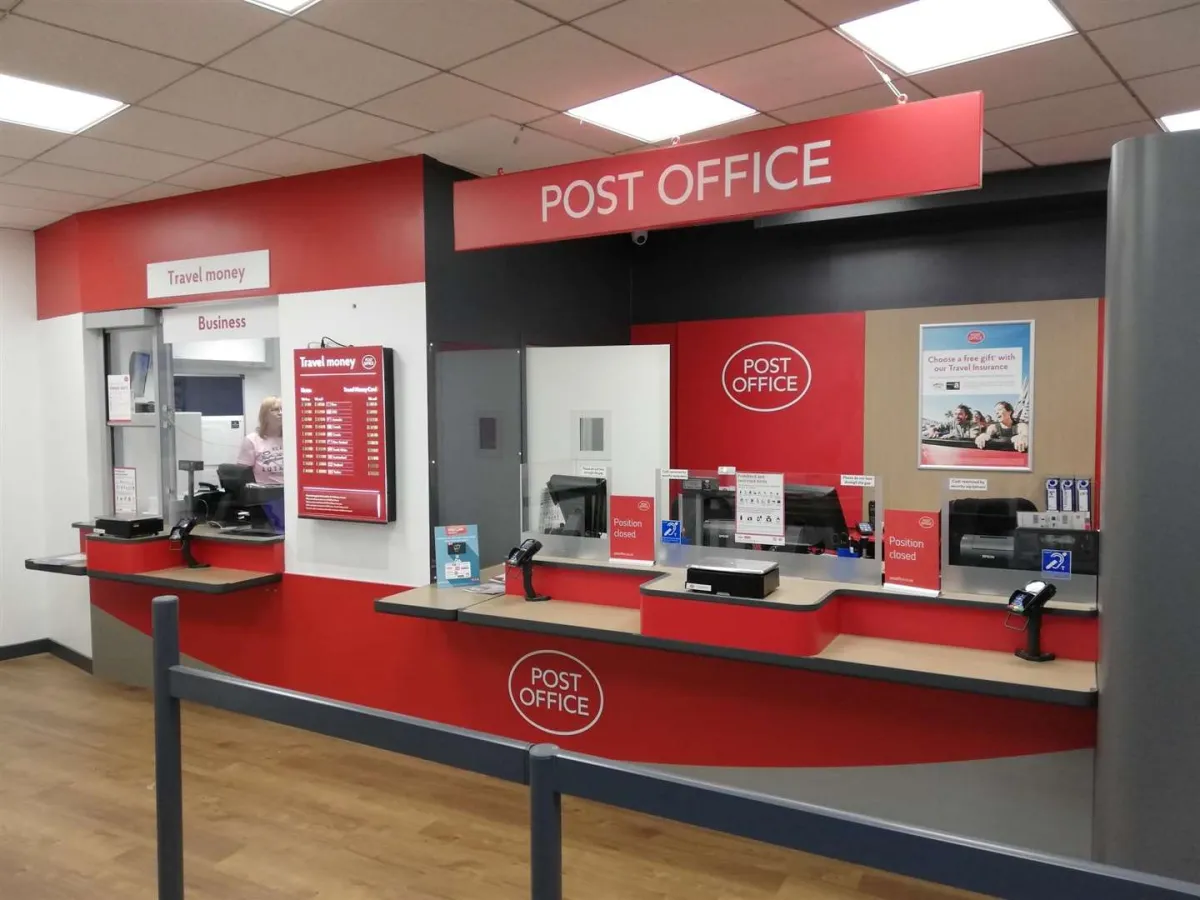 Photo: Post Office, via www.consultationinstitute.org
Brands have understood this assignment completely. The market for 'premium loungewear' in the UK is now worth billions, and it grows every year, because once you have experienced the freedom of a waistband that adjusts to your circumstances rather than demanding you adjust to it, there is no returning to the tyranny of the fixed button.
The Hierarchy of Public Loungewear Deployment
Not all loungewear excursions are created equal. Britain has quietly developed an unspoken taxonomy of acceptable public appearances in elasticated clothing, ranging from the completely uncontroversial to the genuinely bold:
Tier One — Universally Accepted: Collecting a parcel from the doorstep. Bin day. Any interaction with a delivery driver. These are loungewear's home territory and require no justification.
Tier Two — Broadly Tolerated: School run (pre-9am only). Corner shop. Pharmacy. Dog walk. The nation has made its peace with these.
Tier Three — Contested Ground: Parents' evening. Casual Friday at an office that has lost its way. A 'relaxed' birthday lunch at a brasserie. Here, the co-ord is doing heavy diplomatic lifting.
Tier Four — Audacious: Job interview at a company that describes itself as 'creative.' A wedding where the invitation said 'dress comfortably' and someone decided to test that claim. A funeral where the deceased, honestly, would have approved.
Tier Five — Transcendent: The woman in Harrogate. She has moved beyond categories. She is free.
The Industry's Perfectly Calibrated Complicity
What makes the loungewear revolution so beautifully absurd is the fashion industry's enthusiastic participation in its own disruption. Having spent decades selling Britain on the transformative power of structured clothing — the blazer that would change your life, the trouser that would command respect, the heel that would rearrange your posture and therefore your destiny — the industry simply changed the script.
Now the transformation comes through softness. The self-actualisation is elastic. The £95 ribbed jogger from a brand whose name sounds like a Scandi wellness retreat is not a compromise — it is, the marketing copy insists, a choice. A statement. A form of radical self-knowledge.
And the thing is, Britain has accepted this completely. The peace treaty is signed, the border between bedroom and public life has been officially dissolved, and the only remaining question is whether we'll eventually just start wearing actual duvets out and calling them 'oversized wraps.'
Give it eighteen months. There will be a colour called Oatmeal Cocoon. It will sell out in forty minutes.